
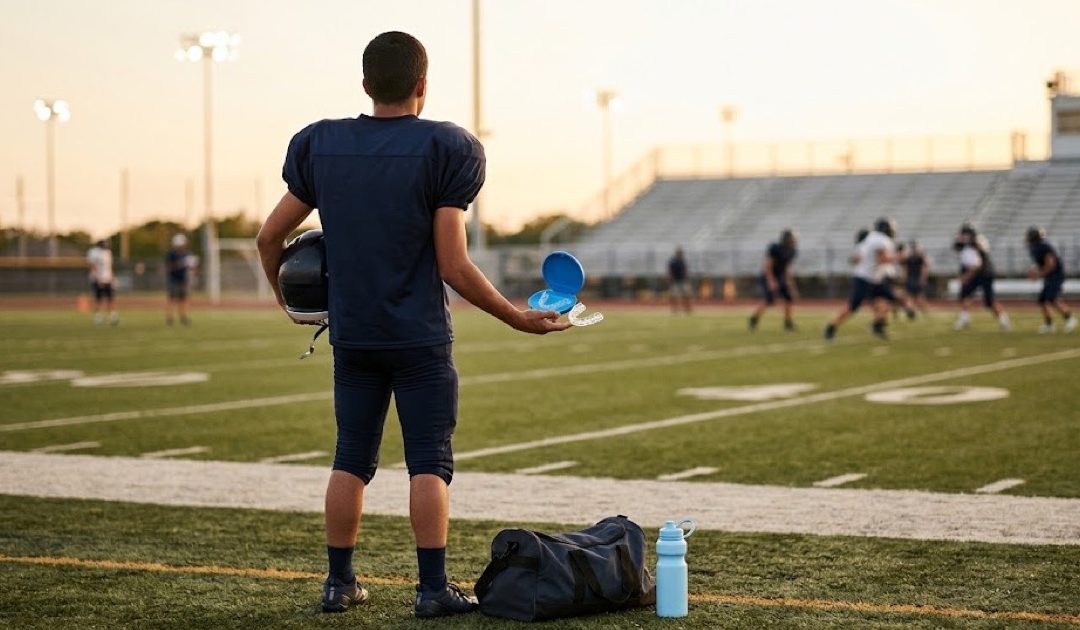
Your teen’s orthodontic consult keeps sliding down the list. Football two-a-days ran through August, volleyball plays three nights a week, and the band has a competition nearly every Saturday through October. Somewhere in there you were supposed to decide about Invisalign, and the easy answer has been “after the season.”
We hear that from parents across McKinney, Allen, Frisco, Plano and Prosper every fall, and the concern is fair. Invisalign only works when the aligners are worn 20 to 22 hours a day. A two-hour practice, a Friday game and three meals look like they could push a teen under that line.
Below, we do the math with you: which sports need the aligners out, why a mouthguard never goes over aligners, how brass and woodwind players adapt, and a weekly aligner-out budget for your teen’s real schedule. We close with our take on starting now versus waiting.
Why the Season Is Rarely a Reason to Wait
Most wear-time worry comes from picturing every activity as aligner-out time. Only eating, brushing and contact sports require removal. Class, homework, bus rides, film study and conditioning are all aligner-in time.
At our office, Dr. Anthony Callison manages pediatric orthodontics and Invisalign for teenagers in McKinney, and the first thing he asks a family in the fall is what the week looks like. Once we map it, most teens have plenty of aligner-in hours. The ones who run short usually have a game-day or tournament problem, and that is a scheduling fix.
Invisalign Teen aligners also carry a small blue compliance indicator that fades with wear. We look at it at each visit, so you get an honest read without turning every dinner into an interrogation.
Class time, conditioning and bus rides are all aligner-in time, so the season eats far fewer hours than parents expect.
Contact Sports: Aligners Out, Mouthguard In
Football, wrestling, lacrosse, hockey, basketball and competitive cheer all involve hits to the face, so the aligners come out and a proper mouthguard goes in. A clear aligner is thin plastic built to move teeth, not a mouth protector. A mouthguard worn over it fits poorly, shifts on impact and can crack the aligner underneath.
The NFHS 2026 football rule change to Rule 1-5-1d(5) bars non-protective attachments on the tooth and mouth protector, as reported by the National Sporting Goods Association, and coaches are checking mouthguards more closely. An aligner under a mouthguard invites a sideline conversation your teen does not want.
The routine we teach:
- Aligners come out in the locker room, straight into the case, before the mouthguard goes in.
- After the final whistle, mouthguard out, quick rinse, aligners back in before the bus.
- Ask us about a custom mouthguard; fit changes as teeth move, so we recheck it midseason.
If your teen takes a hit to the mouth, a loose or chipped tooth needs to be seen the same day. Our team treats sports injuries to teeth and can check whether the aligner still seats afterward.
For contact sports, the aligners come out and a real mouthguard goes in, never one over the other.
Non-Contact Sports: Aligners Stay In
Cross country, tennis, golf, swimming, track and most volleyball practice do not require aligners to come out. Two habits matter here. Water is the only drink with aligners in, since sports drinks get trapped under the plastic, and aligners go back in right after any snack.
If a volleyball coach requires a mouthguard for matches, treat match time as contact time and keep aligners in for practice.
If nothing is going to hit your teen in the mouth, the aligners stay in and the day counts as a full wear day.
Marching Band: Playing With Aligners In
Brass and woodwind players often assume they need to remove aligners for every rehearsal. They do not, and we encourage them not to. Pulling them for every rehearsal and contest would cost more wear time than football.
The embouchure adjusts faster than most students expect. Aligners are smooth and sit close to the teeth, so a trumpet, trombone, clarinet or saxophone player typically needs a week or two to get the same tone back. The students who struggle longest, in our experience, are the ones who keep popping aligners out to check their sound.
A smaller adjustment repeats with each new set, which is why we suggest switching sets on a Sunday night rather than a contest morning. When families compare Invisalign and braces, this is one of the clearest differences: brackets press into the lips under mouthpiece pressure, while aligners have no edges to catch.
Wind and brass players keep aligners in and give the embouchure a week or two to adapt, especially after a new set.
The Weekly Aligner-Out Budget
This is the table we sketch for families. The target is 20 to 22 hours in, which leaves 2 to 4 hours out. Meals and brushing take roughly 1.5 hours; the rest is sport-specific.
| Day type | Aligner-out activities | Hours out | Hours in | Versus 20-hour floor |
|---|---|---|---|---|
| School day, no practice | Three meals, brushing | 1.5 | 22.5 | Above target |
| Contact-sport practice day | Meals, brushing, 2-hour practice, swap time | 3.75 | 20.25 | Just above |
| Friday game day | Meals, pregame meal, warmups and game (about 3 hours) | 5 | 19 | 1 hour short |
| Tournament weekend day | Meals, three matches and warmups across the day | 6 | 18 | 2 hours short |
| Band competition day | Meals only; aligners in for warmup and performance | 1.5 | 22.5 | Above target |
| Cross country or tennis meet | Meals, brushing; race stays aligner-in | 1.75 | 22.25 | Above target |
A single game day at 19 hours will not derail treatment, but a Friday game followed by a Saturday tournament adds up. Three ways to recover:
- Keep aligners in between tournament matches. Two hours out per match is manageable; six straight hours is not.
- Make the day after a game a full wear day: quick meals, no snacking, aligners straight back in.
- If a heavy week leaves your teen consistently short, tell us. We may extend that set a day or two before advancing, which beats moving to a set that does not seat.
Budget the week, not the day; one short game day is fine if the surrounding days are full.
The Sideline Kit Checklist
A small zip pouch in the gym bag prevents most of the problems we see:
- Aligner case. Most lost aligners end up in a pregame napkin or on a locker room bench. See our tips on keeping track of kids’ aligners.
- Mouthguard in its own vented case, separate from the aligners.
- Water bottle, the only drink allowed with aligners in.
- Travel toothbrush for a quick clean after the postgame meal.
- The previous set of aligners as a backup. If the current set is lost or cracked, the old set holds teeth in place until we can help.
- Our number, (972) 547-6453, saved in your teen’s phone. If an aligner goes missing at an away game, call us that day; our page on what to do about a lost aligner covers the first steps.
A case, a backup set and our number in the gym bag cover almost every fall emergency.
Start Now or After the Season? What We Tell Parents
For most teens, the season is not a reason to wait. The math above works for nearly every fall sport and for band. Each month of delay is a month added to the end of treatment, which for a junior or senior can push completion past graduation.
That said, the first two weeks with a new set are the hardest: tender teeth, a day or two of altered speech, an off tone for brass players. So we time the start around the schedule instead of avoiding the season.
A bye week or the days after a rivalry game work well. So does the McKinney ISD fall break on October 12 and 13, per the district calendar covered by Community Impact. For Allen, Frisco, Plano or Prosper schools, check your district’s calendar for the equivalent window.
Most teens should start now, with the first set timed to a bye week or fall break rather than a game week.
Frequently Asked Questions
Q: Should my teen wear a mouthguard over Invisalign aligners during football or volleyball?
A: No. For football and any contact sport, the aligners come out and a properly fitted mouthguard goes in. Aligners are not protective, a mouthguard fits poorly over them, and with the 2026 NFHS rule change on mouthguard attachments, coaches are inspecting mouthguards more closely this season. For volleyball, keep aligners in for practice and follow your coach’s rule for matches.
Q: What happens if practice and games push wear time below 20 hours a day?
A: A single short day is not a crisis. A day at 19 hours followed by full wear days keeps the set on track. If your teen runs short several days in a row, the next set may feel tight or not seat fully, and we may extend the current set a day or two. Tell us rather than guess.
Q: Can my teen play a wind or brass instrument in marching band with aligners in?
A: Yes, and we recommend keeping them in. The embouchure adjusts within a week or two, and removing aligners for every rehearsal costs more wear time than any sport. Switch sets on a Sunday night rather than a contest morning, and keep the case at rehearsal.
Q: Is it better to start Invisalign now or wait until the fall season is over?
A: For most teens, start now. Only eating, brushing and contact play require removal, so a full season fits inside the 20 to 22 hour target with planning. We time the first set around a bye week or fall break so the adjustment does not land on a game week.
Ready to Plan Your Teen’s Invisalign Around the Season?
Bring the practice and competition schedule. Dr. Callison will examine your teen’s teeth, walk through the aligner-out budget for your sports, and give you a clear start date that fits the season. Our free Invisalign consultation FAQ explains what happens at that first visit.
We handle Invisalign, sports injury care and same-day dentistry under one roof at 1760 W. Virginia St, Suite 100 in McKinney, so your teen sees the same team for an aligner check or a Friday night emergency. Call (972) 547-6453 or contact us online to schedule.
Reviewed by the clinical team at McKinney Dentist.
Disclaimer: This content is for educational purposes only and does not replace professional dental or medical advice. A clinical exam is required for diagnosis and treatment planning.