
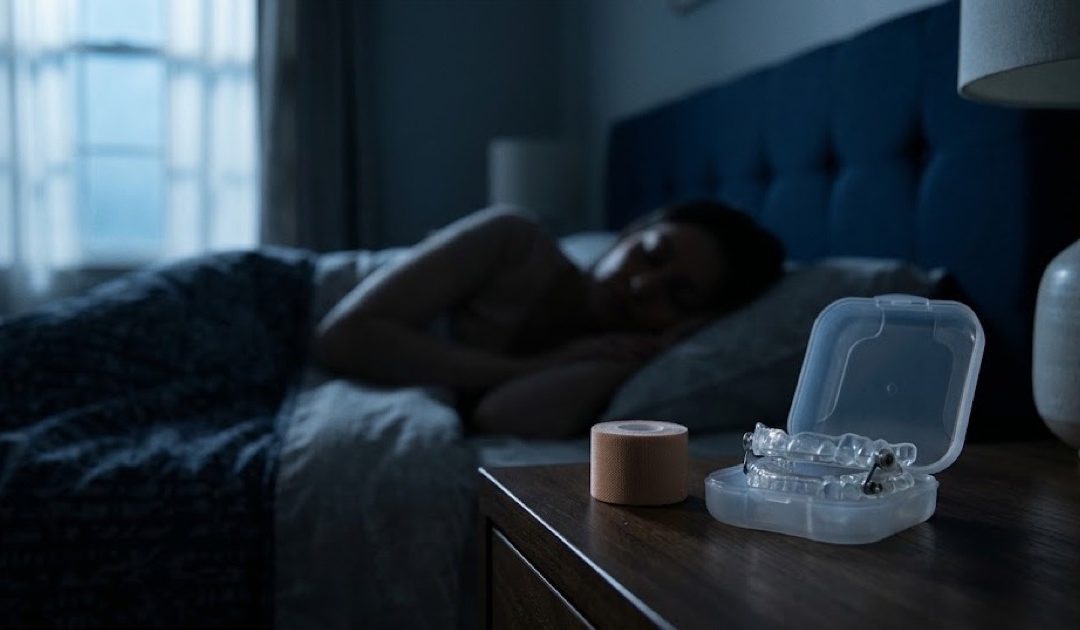
Your partner has moved to the guest room again. You woke with a dry mouth and a dull headache, and you scrolled past another video of someone with tape over their lips, promising quieter nights. A roll costs a few dollars, and trying it seems harmless.
We understand the appeal, and we are not going to lecture you. Mouth breathing really does dry out your mouth and irritate your gums. But our team at McKinney Dentist practices dental sleep medicine, and we see the other side of this trend: patients who muffled the sound for months while the real problem kept going.
Below is what tape can and cannot do, when it is least risky, and how to tell whether your snoring needs a real evaluation before you buy a roll.
Why Mouth Taping Caught On, and What It Actually Does
A strip of porous tape holds your lips together overnight so you breathe through your nose. Nose breathing warms and filters air and keeps saliva where it belongs, so people who wake parched often feel a difference right away.
That is the honest case for tape. The problem is everything else attached to it: deeper sleep, a slimmer jawline, whiter teeth, an end to snoring.
The American Dental Association addressed this in a news piece on mouth taping as a social media trend, noting that claims of better sleep, less snoring and improved dental health remain unproven, and that taping can be risky for people with undiagnosed sleep apnea, asthma or nasal obstruction.
Tape changes where air enters your body and nothing about what happens further down the airway.
The One Thing Tape Cannot Tell You
Snoring is soft tissue vibrating as air squeezes through a narrowed airway. For some people that narrowing stays mild all night.
For others, the tongue and soft palate collapse far enough to block airflow, and the body wakes just enough to reopen the throat, over and over, without the sleeper remembering it. That second pattern is obstructive sleep apnea. From the next pillow, both sound identical.
Tape cannot tell you which one you have, and neither can a snoring app. The collapse happens at the back of the throat, not at the lips. Our page on what happens during a sleep apnea episode explains the mechanics; forcing air through the nose does not hold a collapsed airway open.
If your throat closes during sleep, sealing your mouth removes the backup route your body was using.
Why Quieting the Sound Can Delay the Diagnosis
Snoring is annoying, but it is also useful. It is often the first signal that gets someone into our chair, and in our experience the partner, not the snorer, usually makes the call. Muffle the sound and that pressure to get checked disappears, while untreated apnea keeps affecting blood pressure, heart rhythm, blood sugar and daytime alertness.
We screen for the red flags described on our signs and symptoms of sleep apnea page:
- Gasping, choking or pauses in breathing that a partner has witnessed
- Daytime sleepiness, including dozing off while driving
- Morning headaches
- Waking with a dry mouth or sore throat
- High blood pressure that is hard to control
The symptom people tape over is on that list. A quieter bedroom is not the same as a safer one, and the morning commute in from Frisco on broken sleep is where that difference shows up.
When Your Nose Is the Problem: Allergies, Septum and Ragweed Season
Many people breathe through their mouths at night for a plain mechanical reason: the nose is not moving enough air. Seasonal allergies, chronic sinus congestion, a deviated septum and enlarged turbinates all reduce nasal airflow. Our sleep apnea risk factors page notes that allergies can contribute to sleep apnea.
Ragweed season in North Texas is in full swing by mid-September. Taping your mouth shut when your nose is half-blocked means fighting for air through the one passage that is congested.
If you cannot breathe comfortably through your nose for a full minute while awake, your next step is an ear, nose and throat physician, not tape. When the nose is the reason you mouth-breathe, treating the nose comes before anything you put over your lips.
Before You Tape: A Five-Question Self-Screen and Comparison
Answer honestly. A yes to any one means evaluation comes before tape.
- Has anyone told you that you stop breathing, gasp or choke during sleep?
- Do you feel sleepy during the day after a full night in bed, or have you dozed off while driving?
- Do you wake with headaches, a dry mouth or a sore throat more than a couple of mornings a week?
- Have you been told you have high blood pressure, or do you take medication for it?
- Can you breathe comfortably through your nose with your mouth closed for one full minute right now? (A no here counts as a yes.)
Five no answers put you in the lowest-risk group for trying tape, though they do not prove you are free of sleep apnea.
| Mouth tape | Custom oral appliance | Sleep study, then CPAP | |
|---|---|---|---|
| What it does | Holds lips closed to force nose breathing | Holds the lower jaw forward to keep the airway open | Diagnoses the problem, then splints the airway open with air pressure |
| What it cannot do | Diagnose anything, or reopen a collapsed airway | Replace a diagnosis; fitted only after a physician confirms OSA | Help if the mask goes unused |
| Who it is for | Clear nasal breathing, simple snoring, no red flags | Diagnosed mild to moderate OSA, or patients who cannot tolerate CPAP | Anyone with red flags; first-line for moderate to severe OSA |
| Cost and effort | Low cost, minimal effort, no oversight | Dental visits for fitting and follow-up; worn nightly | Sleep study, then equipment, supplies and nightly use |
Only the sleep study answers the question the other two columns depend on, and tape skips that step entirely.
What We Tell Patients Who Want to Try Taping Anyway
Some patients hear all of this and still want to try it. That is your call. The most common report we hear from patients who did: the tape came off overnight, or it stayed on and they still woke up worn out.
Our guidance lines up with the ADA’s cautions:
- Skip it if you answered yes to any screening question, have asthma, get congested easily, drink alcohol or take sedatives before bed, or have a condition that could cause vomiting during sleep
- Use tape designed for the purpose, placed so you can open your mouth easily
- Try a short nap first, and stop if you wake short of breath, anxious or with a headache
- Never tape a child, or anyone who cannot remove it themselves
- If the snoring is gone but you feel no more rested, treat that as information, not success
Tape is, at best, a comfort measure for adults who already know their snoring is simple snoring. It neither treats sleep apnea nor tells you whether you have it.
How Our McKinney Team Actually Handles Snoring
We do not diagnose sleep apnea; no dental office should. We screen, coordinate and treat once a physician has made the call.
During an exam, we look at your airway, tongue position, jaw shape and the worn enamel that often comes with nighttime grinding, and we ask the screening questions above. We use 3D cone beam imaging when it helps us see the jaw and airway more clearly.
If the picture points toward apnea, we refer you for a sleep study with a sleep physician, often a take-home kit. See how we coordinate sleep apnea care with your physician for the full sequence.
If the study confirms OSA and your physician agrees, we design a custom oral appliance as a CPAP alternative. Many of our patients who could not stick with a mask do wear their appliance. If the study shows simple snoring, there are still snoring relief options that hold the airway open rather than the lips shut.
Either way, you end up knowing what you have, which a roll of tape can never tell you.
Frequently Asked Questions
Q: Is mouth taping safe if I only snore a little?
A: It is least risky for adults who breathe easily through the nose and have no daytime sleepiness, witnessed breathing pauses, asthma or high blood pressure. Light snoring does not tell you which group you are in. Run the five-question screen above first; any yes means get screened before you tape.
Q: Can mouth taping cure sleep apnea?
A: No. Obstructive sleep apnea is an airway collapse at the back of the throat, and tape only changes whether air enters through your nose or mouth. Sealing the mouth in someone with undiagnosed apnea removes a backup route for air, which is why the American Dental Association flags it as risky. Confirmed sleep apnea is treated with CPAP, a custom oral appliance or, in some cases, surgery, under a physician’s direction.
Q: How do I know whether my snoring is actually sleep apnea?
A: You cannot tell from the sound alone, and neither can your partner. A sleep study is the only way to know, often as a take-home kit in your own bed. We screen for warning signs during your exam and refer you to a sleep physician when warranted.
Q: Does a dentist treat snoring, or do I need a sleep doctor first?
A: The order matters. A dentist trained in dental sleep medicine can screen you, spot airway and jaw factors, and help you get a sleep study, but only a physician can diagnose sleep apnea. Once that diagnosis exists, we work with your sleep physician on whether an oral appliance fits, then build and adjust it. If apnea is ruled out, we can still discuss appliance options for simple snoring.
Ready to Find Out What Your Snoring Actually Is?
You do not need a diagnosis to make an appointment. A dry mouth, a tired morning or a partner who has had enough is reason enough.
Our team screens for sleep apnea, coordinates take-home sleep studies with sleep physicians, and fits custom oral appliances when they are the right call, all under one roof at 1760 W. Virginia St, Suite 100 in McKinney. We see patients from Allen, Frisco, Plano and Prosper, with same-day dentistry when something else needs attention.
Call (972) 547-6453 or contact us online to schedule a sleep screening and get clear next steps.
Reviewed by the clinical team at McKinney Dentist.
Disclaimer: This content is for educational purposes only and does not replace professional dental or medical advice. A clinical exam is required for diagnosis and treatment planning.