
A dental emergency while traveling comes with a problem you never have at home: your own dentist is hundreds of miles away. A crown comes off at Thanksgiving dinner or a tooth cracks on pecan brittle the night before your flight, and now you’re choosing between a stranger’s office and four more days of chewing on one side.
Relatives visiting McKinney for the holidays face the same problem in reverse. A tooth breaks during the visit, and they have no local dentist to call.
Our McKinney dental emergency guide covers first aid, problem by problem. This plan covers what changes when you’re away from your own dentist: whether to get seen where you are, how to talk to a new dentist and what to bring home.
Start Here: Rule Out a Medical Emergency
Some problems need an emergency room before they need a dentist. Call 911 or go to the nearest ER for:
- Severe facial swelling
- Facial swelling with a fever
- Trouble breathing or swallowing
- Bleeding from the mouth that won’t stop
- A fall, car accident or hard blow to the face, jaw or head
You’ll still need a dentist afterward. As our post on nighttime toothaches explains, ERs “often cannot provide definitive dental procedures like root canal therapy or crown repair.”
If breathing, swallowing, swelling with fever or a face or head injury is involved, get medical care first and sort out the tooth later.
Fix It There or Fix It at Home? A Decision Table
Many holiday dental problems feel more urgent at 9 p.m. in a guest bedroom than they really are. Use the table to judge whether waiting could harm the tooth or your health; the temporary steps come from our emergency pages and the American Dental Association’s MouthHealthy site.
| Problem | Get seen where you are? | Safe temporary step | OK to wait until home if… |
|---|---|---|---|
| Lost crown or filling | Usually not | Save the crown. Cover sharp edges with dental wax or sugar-free gum. | Discomfort is mild |
| Chipped tooth, no pain | Usually not | Rinse with warm water. Wax over any sharp edge. | No edge is cutting your tongue or cheek |
| Cracked tooth that hurts when you bite | Yes, if pain is severe or getting worse | Rinse with warm water, use a cold compress, chew on the other side | Pain stays mild and there’s no swelling |
| Toothache with facial swelling or fever | Yes, today; ER for severe swelling or swelling with fever | Cold compress on the outside of the cheek | Don’t wait |
| Broken denture or partial | Usually not | Keep every piece and stick to soft foods | No sharp piece is cutting your mouth |
| Knocked-out adult tooth | Yes, right away (ER first if the face or head is hurt) | Hold it by the crown, never the root. Keep it moist: in the socket, between cheek and gum, or in milk. | Never |
Our dental emergency guide has the full knocked-out tooth steps. If you’re unsure about any row, call your own dentist’s office.
A knocked-out tooth, swelling or worsening pain means get seen today, and severe swelling or swelling with fever means the ER. A lost crown or painless chip can usually wait for your own dentist.
Getting Through the Trip Home
A sore tooth makes a long drive or a middle seat feel even longer. If you’ve decided to wait, protect the tooth and stay comfortable until you’re back:
- Never put aspirin on the tooth or gums. Our emergency guide warns it can cause chemical burns. Take pain relievers by mouth as the label directs, and ask a pharmacist what’s safe with your other medicines.
- Don’t dig at it. MouthHealthy advises removing stuck food gently with floss, never with sharp or pointed instruments.
- Eat soft foods on the other side, and skip ice, popcorn kernels and hard candy, which MouthHealthy notes can crack a tooth.
- Keep any pieces in a small container for your appointment.
- Watch for changes. New swelling or climbing pain means get seen where you are, and swelling with a fever means the ER.
A temporary fix is meant to get you home. Book the real repair as soon as you’re back.
How to Find a Dentist You’ve Never Met
An “emergency dentist near me” search in an unfamiliar town gives you names and no way to judge them. Start with people who know you or the area.
- Call your own dentist’s office first. They know your history and can help you decide whether it can wait. If you’re our patient, call (972) 547-6453 and we’ll talk it through over the phone.
- Ask your hosts. The family you’re visiting probably has a dentist, or a neighbor who does.
- Check your dental plan. Your plan’s website or member phone line can point you to in-network offices nearby.
- Call before you drive over. Describe the problem, including any swelling or fever, and ask whether they see new patients for emergencies.
Five Questions to Ask a Dentist You’ve Never Met
Pain makes it hard to think clearly. Write these down before you go:
- “What’s wrong, and can you show me on the x-ray?” Seeing it helps you explain it at home.
- “Is today’s repair temporary or permanent?” Your home dentist needs to know.
- “What’s the least you’d do to get me home comfortably?” Some problems need full treatment now. Others can be stabilized and finished by your own dentist.
- “What will this cost, and will you file my insurance?” Ask before treatment starts.
- “Can you send my x-rays and notes to my dentist?” Get a yes before you leave.
If a recommendation sounds bigger than you expected, ask whether it can wait or call your own dentist before you agree.
What to Bring Back to Your Own Dentist
Your dentist at home can’t see what another office did. Before you leave that office, ask for:
- X-rays, as digital files
- Treatment notes: which tooth, and what they found
- A clear note on anything temporary: a temporary crown or filling, or a root canal that was started but not finished
- Prescriptions and the dates you started them
- An itemized receipt for your insurance
If you’re our patient, call us when you’re back in town. Our emergency guide notes that we typically see emergency patients within 2 to 4 hours of their call during business hours, and we practice Same Day Dentistry.
If you came home with a temporary crown, we’ll talk with you about a permanent dental crown. If another dentist started a root canal, bring the notes; our root canal therapy page explains the treatment.
Pack a Holiday Travel Dental Kit
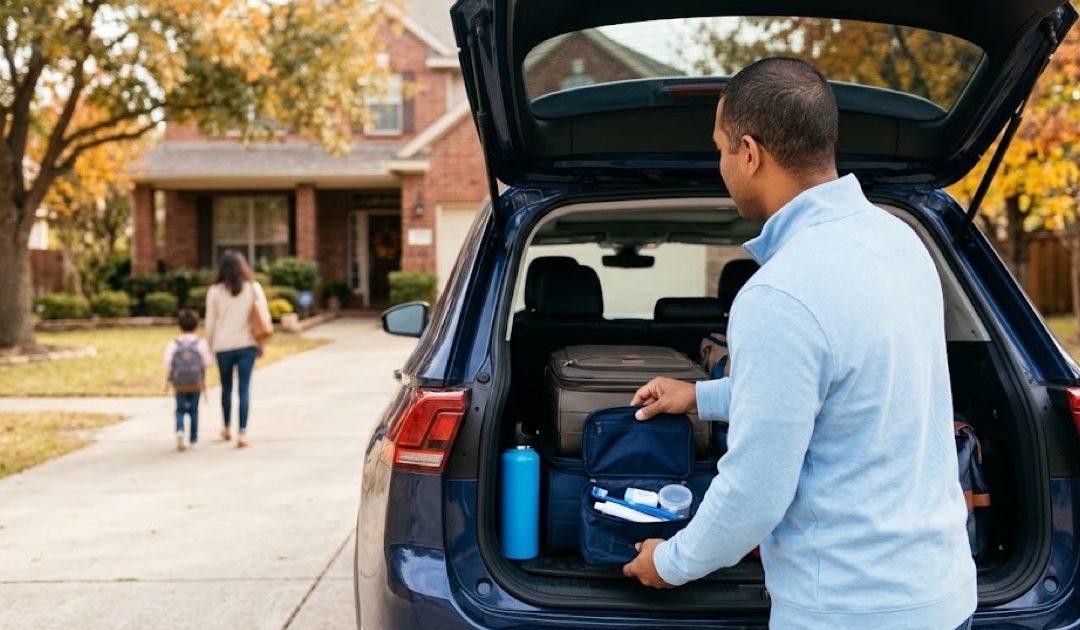
Finding dental wax at 10 p.m. on Thanksgiving in a strange town is harder than packing it. If you’re flying, TSA limits liquids, gels and pastes in carry-ons to 3.4 ounces (100 milliliters) or less per item, in one quart-size bag, and toothpaste counts.
Pack these:
- Toothbrush and travel-size fluoride toothpaste
- Floss for stuck food
- Dental wax or sugar-free gum for sharp edges
- The over-the-counter pain reliever you already use
- A small lidded container for a crown or broken piece
- A photo of your dental insurance card
- Your dentist’s number, saved in your phone
For sweets and keeping your routine over the break, see our holiday teeth care tips.
Keep the kit in your carry-on so it stays with you if a bag is delayed.
For Guests Visiting Family in McKinney
Dental pain in a city where you don’t know any dentists is stressful. If a tooth breaks, a crown comes off or a toothache flares up while you’re in town, call us at (972) 547-6453. You don’t need to be a current patient to call.
Tell us what happened, and we’ll tell you how soon we can see you and what to do in the meantime. Our emergency dentistry care includes:
- Pain diagnosis and relief
- Emergency extractions when a tooth can’t be saved
- Root canal therapy for infected teeth
- Temporary crowns to protect broken teeth
- Emergency fillings and abscess treatment
Hosts looking for an emergency dentist for out-of-town visitors: save (972) 547-6453 in your phone before your guests arrive.
Frequently Asked Questions
Q: Can you see me for a dental emergency if I’m visiting family in McKinney and not a patient?
A: Please call us at (972) 547-6453; you don’t need to be a current patient to call. Tell us what happened, and we’ll let you know how soon we can see you and how to stay comfortable until then. For severe swelling, swelling with fever, trouble breathing or swallowing, or a face injury, call 911 or go to the ER first.
Q: Should I get a lost crown fixed while I’m out of town or wait until I get home?
A: A lost crown with only mild discomfort can usually wait until you’re home. Save the crown, cover any sharp edge with dental wax or sugar-free gum, and see your own dentist soon after you’re back. If the pain turns severe, get seen where you are.
Q: Will an emergency room fix a broken tooth?
A: As our nighttime toothache guide notes, ERs “often cannot provide definitive dental procedures like root canal therapy or crown repair.” Go to the ER first for severe swelling, swelling with fever, trouble breathing or swallowing, or a face or head injury, then follow up with a dentist.
Q: What should I pack in a travel dental kit for the holidays?
A: A toothbrush, travel-size fluoride toothpaste, floss, dental wax or sugar-free gum, your usual pain reliever, a small lidded container and a photo of your insurance card. TSA limits carry-on liquids, gels and pastes to 3.4 ounces (100 milliliters) per item in one quart-size bag, and toothpaste counts.
Travel Safely, and Keep Our Number Handy
A dental problem away from home comes down to two decisions: whether it can wait, and who should fix it. Save the decision table, pack the kit, and leave any unfamiliar office with your records.
Whether you’re a McKinney family heading out of town or a guest staying with one, our team can help when you need an emergency dentist in McKinney, TX. We’re at 1760 W. Virginia St, Suite 100, McKinney, TX 75069.
Call (972) 547-6453 or reach us online. If you’re unsure how urgent it is, call and we’ll help you decide what to do next.
Reviewed by the clinical team at McKinney Dentist.
Disclaimer: This content is for educational purposes only and does not replace professional dental or medical advice. If you have severe swelling, trouble breathing or swallowing, or a serious injury, call 911 or go to the nearest emergency room. A clinical exam is required for diagnosis and treatment planning.