
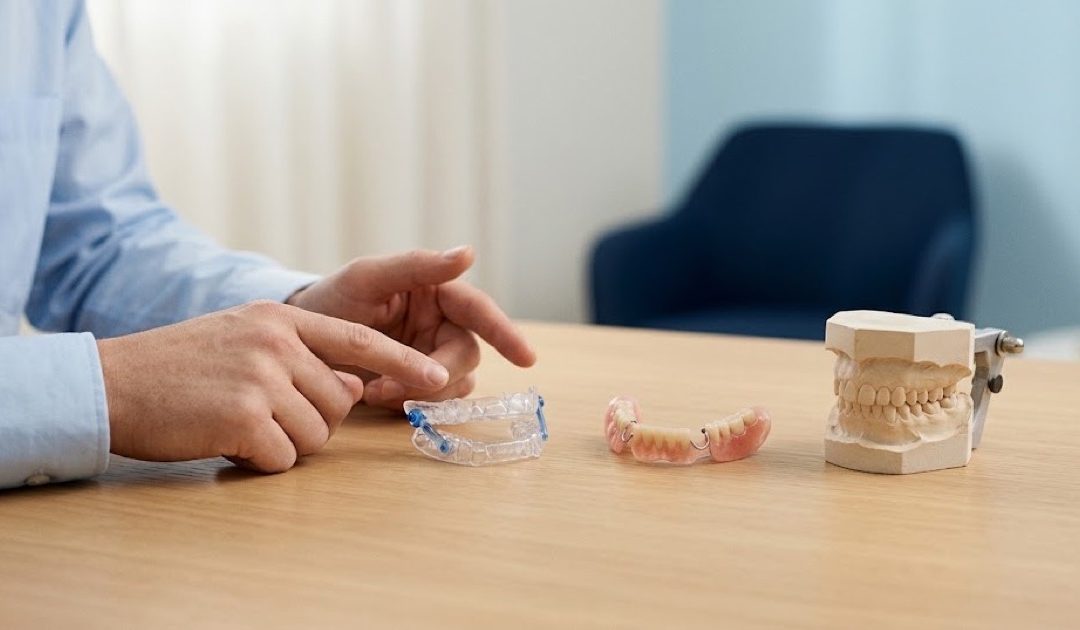
You did the sleep study. You have the diagnosis. And the CPAP has spent more nights on the nightstand than on your face. Then you looked at your partial, or ran your tongue over the gap where a molar used to be, and assumed a sleep apnea mouthpiece was off the table.
That assumption is right for some patients and wrong for others. A mandibular advancement appliance holds your lower jaw slightly forward while you sleep, and it does that by gripping teeth. The question is whether you have enough stable anchorage, and if not, whether we can build some.
At McKinney Dentist, we screen for sleep apnea, help you get a physician’s diagnosis, and design custom oral appliances for sleep apnea. Here is how we assess each situation, what has to be treated first, when implants change the answer, and when CPAP still wins.
How an Oral Appliance Actually Stays in Your Mouth
Most sleep apnea mouthpieces are two custom trays, one per arch, connected so the lower tray sits a few millimeters forward of where your jaw naturally rests. That forward position pulls the tongue base away from the throat.
All of that holding force travels through your teeth. The upper tray braces against the upper teeth, the lower tray pulls on the lower teeth, and your jaw muscles push back all night. Even patients with a full set of healthy teeth can see small bite changes over the years, which is why the American Academy of Dental Sleep Medicine recommends ongoing dental follow-up for anyone in an appliance.
When teeth are missing, loose, or replaced by a denture, the force has fewer places to go and the appliance has fewer places to hold.
Who Diagnoses, Who Builds: Our Role Alongside Your Sleep Physician
We do not diagnose sleep apnea. A sleep physician does, based on a sleep study. Our job comes before and after that step: we screen during your exam, we can send you home with a take-home sleep study kit, and once your physician confirms the diagnosis, we consult with that doctor on whether an appliance fits your type and severity of apnea. More on how our team coordinates sleep apnea treatment with your physician.
We also take a cone beam CT scan of your jaw and airway when planning an appliance. It shows us:
- How much bone remains where teeth have been lost
- Whether the teeth you still have are well supported
- The shape of your airway
If implants may be part of the plan, the CBCT gives us an early read on your bone.
Several Missing Teeth: Usually Workable, With Caveats
A handful of missing teeth rarely rules out an appliance. Molars and premolars provide most of the grip, so two scattered gaps are a very different case from a lower jaw with no molars.
The tray can extend over an empty ridge and wrap the teeth that remain. Existing crowns and fixed bridges can act as anchors once we confirm they will hold up.
The caveat is uneven force. When fewer teeth carry the same pull, each one carries more. A pattern we see often: a lower molar was lost years ago and never replaced, and the premolar in front of it has drifted and worn ever since. That premolar is now what an appliance would lean on. We may recommend replacing one strategic missing tooth before the appliance to spread the load and protect the teeth you have.
Removable Partials and Full Dentures: What Changes at Night
Dentures and partials come out at night so your gums can rest, which is when the appliance goes in. If you wear a partial, your natural teeth are the anchors and the appliance is built to cover the empty spaces. The teeth a partial clasps onto have usually worked the hardest, so we check them closely first. If the partial itself is aging or loose, we can address that in the same plan through our removable dentures and partials service.
A full upper denture paired with natural lower teeth is a middle case. The lower tray has teeth to hold, but the upper tray rests on gum and palate with far less retention, and results vary by design and patient.
A full lower denture is the hard case, because the lower jaw is the one being moved. For patients with no natural teeth on either arch, standard oral appliances are generally not a good option, and CPAP or another physician-directed therapy usually remains the answer unless implants change the picture.
Loose Teeth and Gum Disease: Stabilize Before You Anchor
An appliance tugs on your teeth every night for years. Teeth weakened by gum disease are the last thing you want doing that work, because loading them can speed up the very tooth loss you are working around.
Our sequence:
- Treat active gum disease first through our gum disease treatment program, then reassess mobility once it heals
- Restore or remove teeth with deep decay, failed fillings, or fractured crowns
- Decide which remaining teeth are sound enough to serve as anchors
A tooth with significant mobility cannot serve as an anchor, so we either save it first or plan to replace it.
When Implants Open the Door
Dental implants change the math because they do not move. A few well-placed implants can give an appliance a fixed platform, so an implant retained sleep apnea appliance may be an option for some patients who have lost most or all of their teeth.
The most common version we see is a patient with an implant-supported (snap-in) denture. With the denture out at night, the attachments in the jaw can sometimes retain a sleep appliance tray.
Two limits apply. Not everyone has the bone or general health for implants, Implants also take months to integrate before they can take load, so the appliance comes later. Implants may open options, but we assess candidacy for the implants and the appliance case by case.
Anchor Check: What Your Tooth Situation Means for Appliance Options
Every row assumes a physician has diagnosed your sleep apnea and considers an appliance appropriate.
| Your tooth situation | Realistic appliance options | Treat or stabilize first | Likely first step at our McKinney office |
|---|---|---|---|
| Full natural dentition | Standard mandibular advancement appliance | Active decay, gum disease, failing crowns | Exam, CBCT of jaw and airway, impressions |
| Several missing teeth | Standard appliance, trays extended over gaps | Gum disease; bridges or crowns used as anchors | Exam and CBCT; decide which gaps to bridge versus restore |
| Removable partial denture | Standard appliance around remaining teeth, worn with the partial out | Health of the teeth the partial clasps onto | Evaluate remaining teeth as anchors; refit the partial if needed |
| Full upper or lower denture (other arch natural) | Limited; some designs work with a natural lower arch, a full lower denture rarely | Health of the natural arch; denture fit | Candidacy talk, CPAP discussion, implant evaluation |
| Implants or implant-supported denture | Implant retained appliance using existing attachments | Confirm implants are healed and healthy | Review implant positions on CBCT; design tray to engage attachments |
What to bring to your first appliance consult
- Your sleep study report and the physician’s diagnosis, including severity
- Your CPAP settings and a plain description of why it has not worked
- Your denture or partial, even though you will not wear it with the appliance
- A list of medications and any jaw pain, clicking, or morning headaches
When CPAP Is Still the Right Answer
We would rather give you a clear no than fit a device that will not hold. For severe obstructive sleep apnea, CPAP remains the first-line treatment in physician guidelines, and an appliance may serve as a travel backup or part of combination therapy.
CPAP also stays the answer when anchorage cannot be built: no teeth, no implants, and no plan for either. The same goes for jaw joint problems that forward positioning would aggravate. If an appliance is unlikely to work for you, we will say so and coordinate with your sleep physician on the next option.
See also: implant-supported dentures versus traditional dentures.
Frequently Asked Questions
Q: Can I wear a sleep apnea mouthpiece if I have a full denture?
A: It depends on the other arch. A full upper denture with natural lower teeth can sometimes work with a design built for that situation. A full lower denture with no implants is rarely workable, because the lower jaw is the one being advanced. If you have no natural teeth at all, implants are usually the only path that changes the answer, and even then it is assessed case by case.
Q: How many teeth do I need for an oral appliance to stay in place?
A: No single number applies to everyone. You may see commonly cited guidance of roughly eight to ten healthy teeth per arch, and we treat that as a starting point rather than a rule. Position matters more than count: healthy molars and premolars on both arches provide far more retention than the same number of front teeth. We evaluate each remaining tooth, then decide whether to design around your gaps or replace one first.
Q: Can dental implants make me a candidate for an oral appliance?
A: They may. Implants give the appliance fixed anchorage, and an existing implant-supported denture can often retain a sleep appliance through its attachments. Candidacy for the implants themselves depends on bone volume and general health, which we assess with a CBCT scan. See our page on dental implants for seniors in McKinney for how age and health factor in.
Q: Will loose teeth or gum disease stop me from getting an appliance?
A: Not permanently, but they will pause it. Active gum disease has to be treated and healed before we ask those teeth to anchor anything, and teeth with significant mobility are stabilized or replaced first. Once your gums are healthy and we know which teeth are sound, we reassess.
Ready to Find Out Whether an Appliance Can Work for You?
If you have missing teeth or a denture and cannot tolerate CPAP, you deserve a specific answer. At McKinney Dentist, we screen, image, and build sleep appliances under the same roof where we place implants and fit dentures.
Bring your sleep study, CPAP settings, and denture or partial, and we will walk through the anchor check in person. Call (972) 547-6453 or request an appointment online. We serve McKinney, Allen, Frisco, Plano, and Prosper, with same-day dentistry available when your plan calls for it.
Reviewed by the clinical team at McKinney Dentist.
Disclaimer: This content is for educational purposes only and does not replace professional dental or medical advice. A clinical exam is required for diagnosis and treatment planning.